
About the Author

Executive Summary
The question facing most organizations is no longer whether to modernize the data platform based on a prescribed data maturity journey. That debate is settled. The difficult, expensive, and consequential question is what to modernize to. Between the traditional data warehouse, the lakehouse architecture, and Microsoft Fabric, technology leaders face three credible options whose marketing materials make nearly identical promises.
This whitepaper cuts through that overlap. It compares the three approaches through an enterprise architecture lens and provides a structured framework for evaluating platform fit based on four axes: organizational maturity and skills, analytics requirements, governance and compliance obligations, and total cost including existing investments.
This paper deliberately avoids positioning Microsoft Fabric as a silver bullet. Fabric is a genuinely significant platform that resolves real problems, but it is a choice, not a default. There are organizations for whom a well-run data warehouse remains the correct answer for years to come, and organizations whose existing lakehouse investments make a wholesale move to Fabric an expensive duplication rather than a modernization.
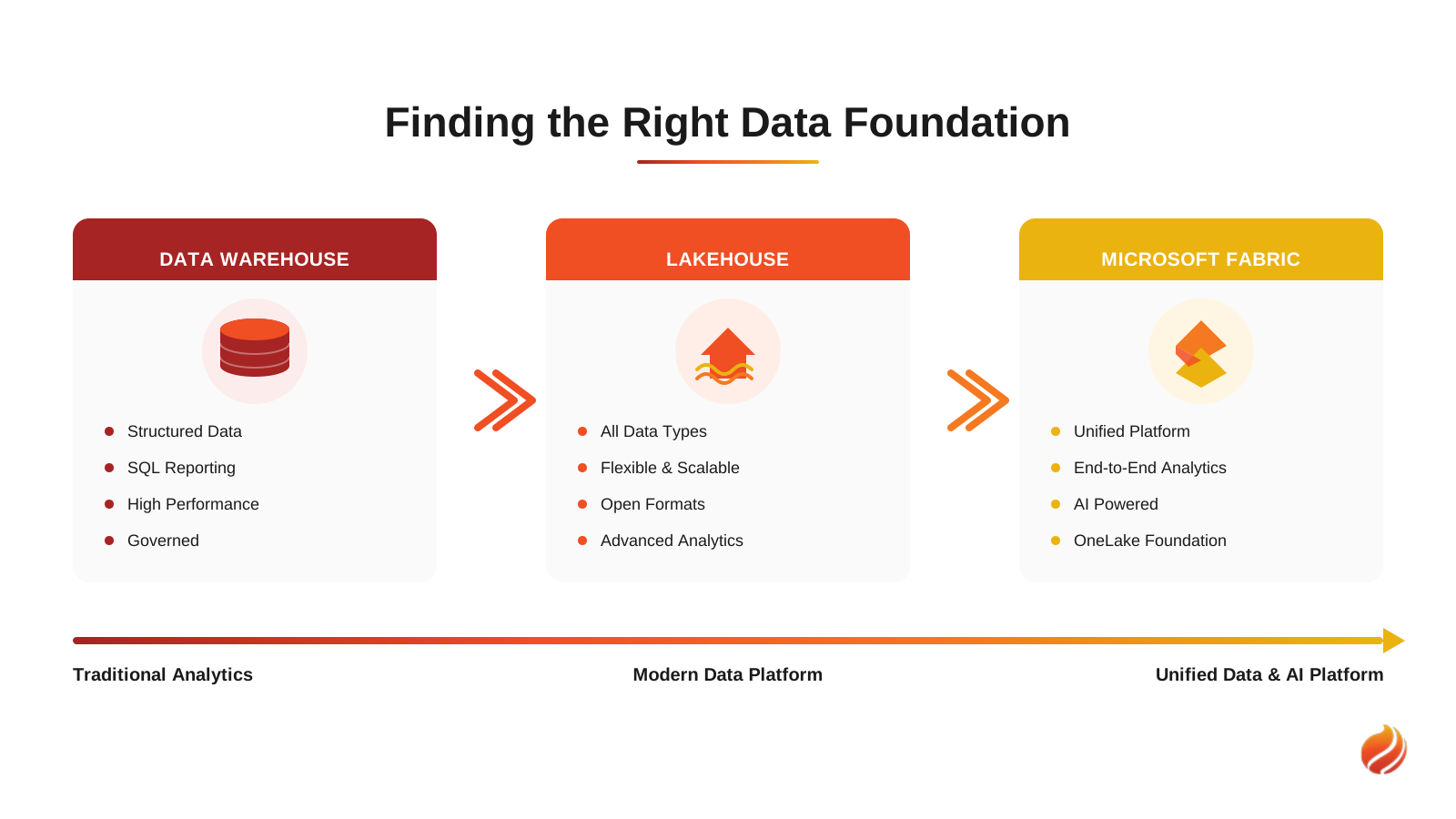
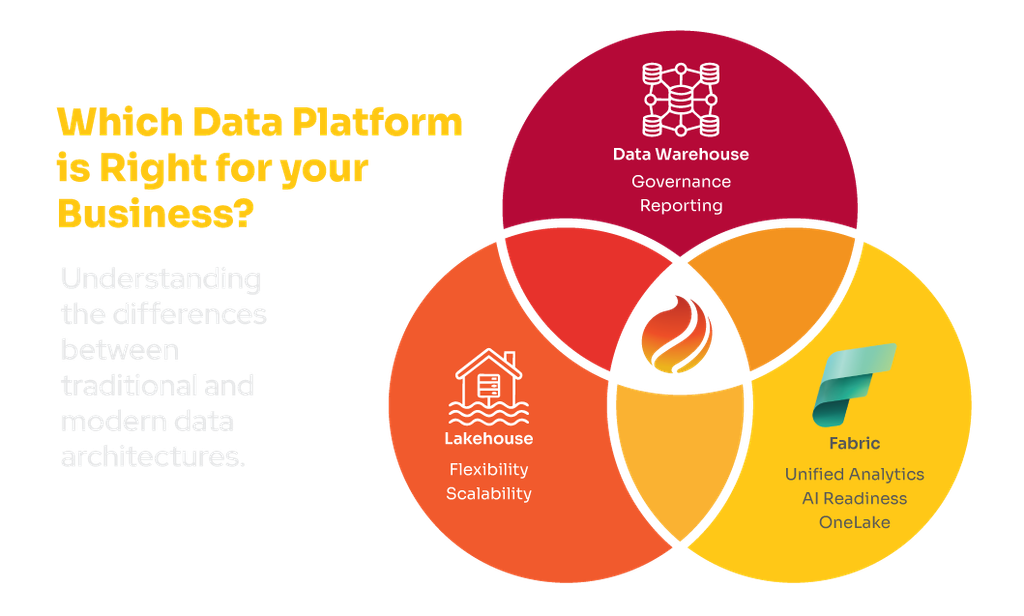
The central thesis: warehouse, lakehouse, and Fabric are not three competitors but three points on a broader spectrum of capability, flexibility, and operational burden. The right choice is the one that matches where your organization actually is — not where a vendor roadmap says the industry is going.
1. The Real Question: Modernize To What?
Over the past decade, the case for modernizing analytics infrastructure has become self-evident. Legacy on-premises warehouses struggle with volume, variety, and velocity. Business demand for self-service analytics, machine learning, and near-real-time operational visibility has outgrown the nightly batch model. Cloud economics have made elastic compute affordable. Few executives now argue against modernization in principle.
What has not become clear is the destination. Three architectural patterns compete for the same budget:
- The cloud data warehouse — a mature, structured, SQL-centric platform optimized for governed business intelligence.
- The lakehouse — an open, file-based architecture that unifies data lake flexibility with warehouse-like transactional reliability.
- Microsoft Fabric — a software-as-a-service platform that unifies both patterns, plus integration and BI, under a single commercial and governance model.
1.1 Why The Categories Blur
Vendor marketing has deliberately eroded the distinctions. Warehouse vendors now advertise support for semi-structured data and machine learning. Lakehouse vendors advertise warehouse-grade SQL performance and governance. Fabric advertises that it is all of the above. Every platform claims every capability.
Architecture must therefore re-establish the distinctions that marketing has blurred. The useful differences are no longer about what a platform can technically do — increasingly, they can all do most things — but about:
- What each platform is optimized for, and therefore what it does well without heroic effort.
- What skills it demands of the team that must operate / maintain it every day.
- What it costs across a realistic multi-year horizon, including people
- What governance it provides out of the box versus what you must build.
Vendor marketing has deliberately eroded the distinctions. Warehouse vendors now advertise support for semi-structured data and machine learning. Lakehouse vendors advertise warehouse-grade SQL performance and governance. Fabric advertises that it is all of the above. Every platform claims every capability.
Architecture must therefore re-establish the distinctions that marketing has blurred. The useful differences are no longer about what a platform can technically do, increasingly, they can all do most things, but about:
- What each platform is optimized for, and therefore what it does well without heroic effort.
- What skills it demands of the team that must operate / maintain it every day.
- What it costs across a realistic multi-year horizon, including people
- What governance it provides out of the box versus what you must build.
1.2 The Cost Of Choosing Unwisely
Platform decisions are expensive to reverse. A misaligned choice typically manifests in one of three ways: an over-engineered platform that the organization lacks the skills to operate (shelfware with a monthly bill); an under-powered platform that cannot serve emerging requirements (forcing a second migration within 24 months); or a duplicated platform that overlaps existing investments (paying twice for the same capability). Each outcome damages credibility as much as budget, which is why the decision must be defensible under executive scrutiny.
2. The Data Warehouse
The data warehouse is the oldest and most mature of the three patterns, and it remains the correct answer more often than modernization narratives suggest.
2.1 Architectural Characteristics
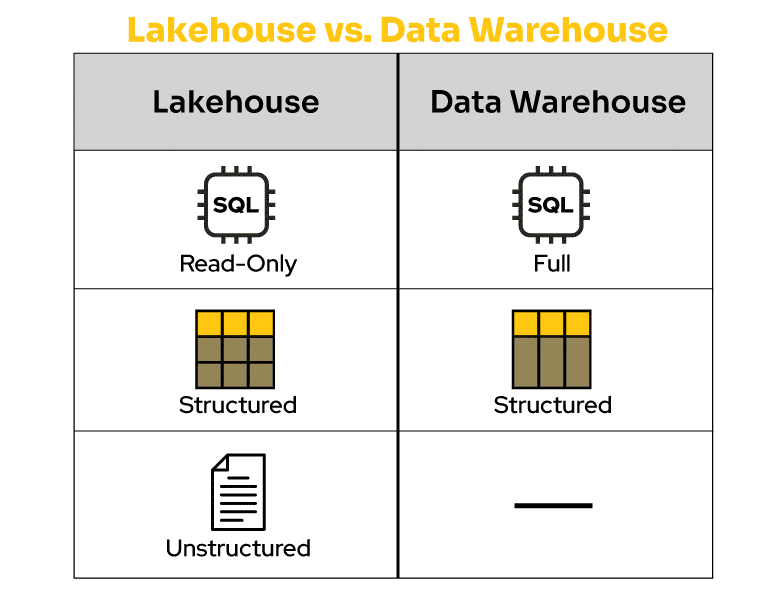
A data warehouse is a centralized, schema-on-write repository optimized for analytical queries over structured, relational data. Data is extracted from source systems, transformed to conform to a defined model (typically a star or snowflake schema), and loaded into tables designed for fast aggregation. Modern cloud warehouses separate storage from compute, allowing each to scale independently, and use columnar storage with heavy compression.
The defining characteristic is schema-on-write: structure is enforced at load time. Data that does not conform is rejected or corrected before it lands. This discipline is the source of both the warehouse’s greatest strength and its principal limitation.
2.2 Strengths

Mature governance
and security
Decades of enterprise use have produced robust, well-understood controls: role-based access, column and row-level security, auditing, encryption, and data masking, all natively supported and familiar to auditors.

Predictable, high performance for BI
Purpose-built query optimizers, statistics, indexing, and materialized views deliver consistent sub-second response for the aggregation-heavy queries that dashboards generate.

Ubiquitous skills
SQL is the most widely held data skill in the enterprise. Hiring, training, and vendor support are straightforward, and the operating model is well understood.

Data quality by construction
Schema enforcement at load time catches structural problems early, before they reach a report.

Operational maturity
Backup, disaster recovery, monitoring, and performance-tuning practices are established and documented.
2.3 Limitations
Poor fit for unstructured and
semi-structured data
Documents, images, logs, telemetry, and free text are awkward at best. Support for JSON and similar formats exists but is bolted on rather than native.

Rigidity and change cost
Schema changes ripple through ETL, models, and reports. Adding a new source can take weeks of engineering rather than days.

Weak support for data science and
machine learning
Data scientists typically extract data out of the warehouse into another environment, creating copies and undermining the single-source-of-truth premise.

Batch orientation
Traditional warehouse loading patterns assume periodic batches; real-time and streaming scenarios require additional architecture.

Cost of scale for new workloads
Storing large volumes of raw or rarely queried data in
warehouse storage is expensive relative to object storage.
2.4 When A Warehouse Is Still The Right Answer
Choose or retain a data warehouse when your analytics demand is predominantly structured financial and operational reporting; when your team’s skills are SQL-centric; when governance and auditability are paramount (regulated industries frequently fall here); and when you have no near-term requirement for machine learning, streaming, or unstructured data. A well-run warehouse serving reliable executive reporting is not technical debt — it is a functioning asset.
3. The Lakehouse
The lakehouse emerged to resolve a genuine architectural problem: organizations were running both a data lake (cheap, flexible, but unreliable) and a data warehouse (reliable, but rigid and expensive), copying data between them and reconciling the differences.
3.1 Architectural Characteristics
A lakehouse stores data as open-format files — typically Parquet — in low-cost object storage, and adds a transactional metadata layer (Delta Lake, Apache Iceberg, or Apache Hudi) on top. That layer supplies the properties that raw data lakes lack:
- ACID (Atomicity, Consistency, Isolation, and Durability) transactions, so concurrency reads and writes do not produce corrupt or partial results.
- Schema enforcement and evolution, allowing controlled structural change over time,
- Time travel, enabling queries against prior versions of a table for audit or reprocessing
- Efficient upserts and deletes, which raw Parquet on object storage cannot do well.
The organizing convention is the medallion architecture: bronze (raw, as-ingested), silver (cleansed and conformed), and gold (curated, business-ready, typically dimensional). This provides progressive refinement while preserving an auditable raw copy.
3.2 Strengths

Economical at scale
Object storage is dramatically cheaper than warehouse storage, making it viable to retain full-fidelity history.

Schema-on-read flexibility
Data can be landed first and structured later, shortening the path from source to availability

Unified platform for analytics and AI
Data scientists work against the same tables that feed BI, eliminating extract-and-copy patterns.

Handles all data types
Structured tables, semi-structured JSON, and unstructured files coexist in one store, supporting BI, machine learning, and streaming from the same foundation.

Open formats reduce lock-in
Because data is Parquet with an open table format, multiple engines can read it, and migration between vendors is materially easier.
3.3 Limitations
| Governance is largely do-it-yourself | Cataloging, lineage, classification, and access policy must be assembled from additional tools and disciplined practice. The platform does not enforce them for you. |
| Significant engineering skill required | Spark, distributed computing concepts, file compaction, partitioning strategy, and cluster tuning are real operational responsibilities. |
| Quality is a practice, not a guarantee | Schema-on-read flexibility permits inconsistent, duplicated, and poorly documented data to accumulate — the “data swamp” failure mode. |
| Variable BI performance | Without careful curation of the gold layer, interactive dashboard performance can lag a tuned warehouse. |
| Higher operational overhead | Someone must own table maintenance, job orchestration, and cost control. |
3.4 When A Lakehouse Is The Right Answer
Choose a lakehouse when you have genuinely varied data (not merely aspirations to it); when machine learning and advanced analytics are active, funded requirements rather than future possibilities; when data volumes make warehouse storage economics painful; when you have or will hire real data engineering capability; and when avoiding vendor lock-in is a strategic priority.
4. Microsoft Fabric
Fabric is Microsoft’s initiative to deliver both patterns as a single software-as-a-service product, removing the infrastructure and integration burden that both traditionally impose.
4.1 What Is Architecturally Different?
- SaaS rather than PaaS. There are no clusters, storage accounts, or integration runtimes to provision, size, patch, or scale. Microsoft operates the platform; you purchase capacity.
- OneLake as a unified storage foundation. A single, automatically provisioned, tenant-wide data lake underlies every workload, storing data in open Delta-Parquet.
- Multiple engines over one copy of data. Warehouse (T-SQL), lakehouse (Spark), real-time analytics, data science, and Power BI all read and write the same OneLake tables without copying. Transactional data sources are now available as well, including SQL Server, PostgreSQL, and Cosmos DB.
- Unified commercial model. One capacity meter covers all workloads, replacing separately billed services. One invoice.
- Governance built in. Microsoft Purview integration provides cataloging, lineage, and classification natively rather than as a separately assembled layer and practice.
- Direct Lake for BI. A semantic model mode that reads Delta files and Warehouse tables directly from OneLake, approaching import-mode performance with near-live freshness and no data duplication.
4.2 Strengths

Dramatically lower
operational burden
Organizations without a platform engineering team can run capabilities that previously required one.

Lower skill barrier
Power Query (Dataflows Gen2) and Power BI cover a large share of requirements without Spark or Python, making the platform accessible to analysts.

Genuine integration
Because the workloads were designed together, the seams between ingestion, storage, modeling, and reporting are far smaller than in assembled architectures.
Strong Power BI
continuity
Existing Power BI investments, skills, and content carry forward; Fabric is an extension of a platform most enterprises already run.
4.3 LimiTATIons And Honest Trade-Offs
- Relative immaturity.
Fabric is far newer than either alternative. Features evolve rapidly, which brings both improvement and churn; some capabilities lag their PaaS equivalents. - Capacity-based cost model.
All workloads consume from a shared capacity. This simplifies billing but requires active monitoring: noisy workloads can throttle interactive reporting, and right-sizing is an ongoing discipline. - Microsoft-centric.
Fabric is most compelling for organizations already committed to the Microsoft stack. Heterogeneous estates may find the fit less natural. - Less granular control.
The SaaS model that removes operational burden also removes tuning levers that sophisticated engineering teams may rely on. - Overlap risk. F
or organizations with existing Synapse, Databricks, or warehouse investments, Fabric can duplicate capability rather than replace it — the single most common source of wasted spend, though migration / integration paths exist.
5. Side-By-Side Comparison
The following criteria are the ones that reliably differentiate the three options in real evaluations.
| Criterion | Data Warehouse | Lakehouse | Microsoft Fabric |
|---|---|---|---|
| Best For | Structured BI and finance reporting | Big data, ML, mixed data types | Unified BI plus data science, Microsoft-centric estates |
| Data Types | Relational tables | Files, tables, streaming, unstructured | All, unified through OneLake |
| Schema Approach | Schema-on-write | Schema-on-read with enforcement available | Both, by workload |
| Governance | Strong and mature | Do-it-yourself; assembled | Built in via Purview |
| Skills required | SQL and BI | Data engineering, Spark | Mixed; materially lower barrier |
| Operational burden | Moderate | High | Low (SaaS) |
| Cost model | Compute plus storage | Compute plus cheap object storage | Capacity units (F SKUs) |
| Vendor lock-in | Higher; proprietary formats | Lower; open formats | Moderate; open format, Microsoft platform |
| BI performance | Excellent and predictable | Good with curation | Excellent via Direct Lake |
| ML and AI support | Limited | Excellent | Strong and integrated |
| Maturity fit | Established teams | Advanced, engineering-led | Growing, Microsoft-first |
Read this table as a description of defaults and gradients, not absolutes. Any cell can be overcome with sufficient investment; the question is whether your organization should spend that investment.
6. OneLake And Its Impact On Enterprise Data Design
OneLake deserves separate discussion here because it changes design assumptions that have held for years, and it is the component most likely to alter an architectural conclusion.
6.1 One Logical Lake Per Tenant
OneLake is provisioned automatically with the tenant — there is exactly one (per tenant), and it cannot be fragmented into competing storage accounts by well-meaning teams. This is a deliberate constraint. Traditional lake architectures decay into silos because each department provisions its own storage; OneLake removes that possibility at the platform level while still allowing logical separation through workspaces and domains.
6.2 Shortcuts: Reference, Do Not Copy
Shortcuts are pointers that surface data residing elsewhere — another workspace, Azure Data Lake Storage, Dataverse, Amazon S3, or Google Cloud Storage — as though it were local, without physically copying it. The architectural implications are substantial:

Existing lakes can be
adopted in place
An organization with a mature Databricks or Synapse lake can expose it to Fabric without migration, dramatically lowering the cost of evaluation.

Cross-domain sharing
without duplication
A finance domain can reference a conformed customer dimension owned by a master-data domain rather than copying it.

Multi-cloud reach
Data in Amazon S3 can participate in Fabric analytics without egress-heavy replication.
Shortcuts convert what would otherwise be a migration decision (and possibly a security risk) into an incremental adoption decision. this is often the single most important fact in an evaluation.
6.3 Open Format As An Exit Strategy
Because OneLake persists data as Delta-Parquet, the data itself is portable. Semantic models, pipelines, and reports are Microsoft-specific, but the underlying tables are not. When assessing lock-in risk, distinguish clearly between data lock-in (low) and platform and tooling lock-in (real, and comparable to any managed platform).
6.4 Design Consequences
- Domains become the primary organizing unit. With storage unified, logical ownership boundaries matter more than physical ones. Fabric domains and sub-domains map well to a data-mesh-inspired model where business areas own their data products.
- Copy-reduction becomes a design goal. Architectures should be evaluated on how few copies of a given dataset they produce, since duplication is now avoidable rather than inevitable.
- Governance must be centralized early. A single lake accessible to many workloads magnifies the consequences of weak access control.
7. Where Fabric Overlaps Existing Investments
The most expensive mistake in Fabric adoption is paying twice for the same capability. Map overlaps explicitly before committing.
7.1 Existing Azure Synapse Analytics
Fabric is, in substance, the SaaS successor to much of Synapse. Organizations running Synapse dedicated SQL pools, Spark pools, and pipelines will find Fabric duplicates all three. Here the decision is genuinely replace / migrate, on a planned timeline, rather than complement. Continuing to fund both indefinitely is difficult to defend.
7.2 Existing Databricks or Spark Platforms
The overlap is real but the relationship is more nuanced. Mature Databricks estates typically have sophisticated engineering practices, established ML operations, and significant sunk investment. Because both speak open Delta, the pragmatic pattern is coexistence: keep Databricks for engineering and ML workloads, use OneLake shortcuts to expose curated tables, and use Fabric for BI and business-facing self-service. Forced consolidation rarely produces net savings in the short term.
7.3 Existing Power BI Premium
Premium capacities include Fabric workloads. Many organizations can therefore evaluate and even run initial Fabric workloads on capacity they already own, deferring incremental spend. This materially lowers the cost of a proof of concept and should be confirmed before any new purchase.
7.4 Existing On-Premises Or Cloud Warehouses
A functioning warehouse serving stable reporting is rarely worth replacing on its own merits. The stronger pattern is to leave it in place, surface it into the lake for combined analysis, and migrate workloads opportunistically as they require capabilities the warehouse cannot provide.
7.5 The Overlap Question Set
For every existing platform, answer three questions explicitly and in writing: does Fabric replace it, complement it, or should the decision be deferred? Any component without a clear answer is a budget risk.
8. A Decision Framework
Rather than comparing feature lists, score platform fit on four axis. Each axis should be assessed honestly against the organization as it is today, not as leadership aspires for it to be.
8.1 Axis One
Organizational Maturity And Skills
Assess the team you actually have. Key questions: Do you employ data engineers, or analysts who write SQL? Who will operate the platform at 2 a.m. when a load fails? Is there an existing practice of version control, testing, and deployment for data assets? A platform that exceeds your operating capability will underdeliver regardless of its technical merit. This axis disqualifies more options than any other.
8.2 Axis Two
Analytics Requirements
Distinguish funded, committed requirements from aspirations. Questions: Is the workload predominantly structured BI, or does it include machine learning, streaming, or unstructured content? What latency does the business genuinely require — monthly, daily, hourly, or sub-minute? How many concurrent users, and what query patterns? Architectures are frequently over-built for hypothetical future needs; require a named sponsor and budget before a requirement influences the decision.
8.3 Axis Three
Governance And Compliance
Questions: What regulatory regimes apply (financial reporting, healthcare privacy, regional data residency)? Must you demonstrate end-to-end lineage to an auditor? Is sensitive data classification mandatory? Is row-level or column-level security required across a shared estate? Where obligations are heavy and the team is small, a platform with built-in governance is worth a substantial premium over one where governance must be assembled.
8.4 Axis Four
Total Cost And Existing Investments
Questions: What is already owned and paid for? What is the three-year total cost including licensing, infrastructure, migration, and — critically — people? What is the cost of not deciding, in duplicated effort and delayed insight? Platform license cost is frequently the smaller share of TCO; staffing and migration usually dominate.
8.5 Scoring In Practice
Score each platform one to five on each axis, weight the axes according to organizational priority, and document the rationale for every score. The output is not a mechanical winner but a defensible, transparent argument. When an executive challenges the recommendation, the scoring sheet — not the vendor deck — is the artifact that survives scrutiny.
9. Aligning Platform Choice With Maturity
Maturity, more than technology preference, should drive the decision. The following ladder is a practical experiment.
| Maturity stage | Characteristics | Primary need | Lean toward |
|---|---|---|---|
| Foundational | Spreadsheet-driven; inconsistent definitions; no central data team | Standardize and trust core reporting | Data warehouse (or Fabric warehouse) with disciplined modeling |
| Scaling | Central BI exists; growing data variety and volume; first ML experiments | Handle varied data economically | Lakehouse, or Fabric if the team is small and Microsoft-centric |
| Advanced | Mature BI and engineering; production ML; multiple domains | Unify BI and AI; reduce operational sprawl | Fabric for consolidation, or a best-of-breed lakehouse where engineering depth is strong |
Two cautions.
First, maturity is not linear across an organization: finance may be foundational while marketing runs production ML. Score the dominant workload and plan for exceptions. Second, resist skipping stages. An organization that cannot agree on the definition of “revenue” will not be rescued by a lakehouse; it needs the modeling discipline of the foundational stage first.
10. Total Cost of Ownership
Credible TCO analysis is what converts an architectural preference into an approved budget.
10.1 Cost Components to Model
- Platform licensing and compute. Warehouse compute and storage; lakehouse cluster time and object storage; Fabric capacity units, reserved instance or pay-as-you-go.
- Storage growth. Model three years of growth, not current volume. Object storage economics increasingly favor lake-based patterns at scale.
- People. The dominant cost in most models. A lakehouse requiring two data engineers costs far more annually than the difference between any two license tiers.
- Migration. One-time but frequently underestimated: rebuilding pipelines, re-validating reports, parallel running, and change management.
- Tooling gaps. Catalog, quality, and orchestration tools that one platform includes and another requires you to buy.
- Opportunity cost. Analyst hours consumed by manual work the platform would eliminate.
10.2 Fabric-Specific Cost Dynamics
Fabric’s capacity model has characteristics worth modeling explicitly. Consumption is smoothed over time, so brief spikes are absorbed rather than failing. Sustained overconsumption leads to throttling rather than surprise overage bills — predictable but potentially disruptive. Pay-as-you-go capacity can be paused, making non-production environments materially cheaper. Reserved capacity offers meaningful discounts for stable workloads. Because all workloads share the meter, a poorly written notebook can degrade executive dashboards, making monitoring through the Capacity Metrics app an operational requirement rather than a nicety.
10.3 Presenting Cost to Executives
Presenting three years, not one. Show the run rate of the status quo alongside the proposal. Modernization often competes against an unexamined baseline that is itself expensive. Separate one-time migration cost from ongoing run cost. State assumptions explicitly, and identify the two or three variables to which the model is most sensitive.
11. Governance And Compliance Considerations
Governance capability differs sharply across the three options and is frequently the deciding factor in regulated environments.

Cataloging and discovery
Warehouses offer strong internal metadata but limited enterprise-wide discovery. Lakehouses require an external catalog. Fabric integrates Purview for tenant-wide cataloging.

Lineage
Warehouse lineage is typically confined to its own ETL. Lakehouse lineage must be instrumented and deployed. Fabric with Purview can trace source-to-report lineage across the estate — often decisive for audit.

Classification and sensitivity
Fabric supports Microsoft Information Protection labels that persist downstream, including into exports. Equivalent capability in a lakehouse requires deliberate construction.

Access control granularity
All three support role-based access; warehouses have the most mature column and row-level controls, though Fabric’s OneLake security and semantic-model RLS (and OLS) have closed much of the gap.

Data residency and sovereignity
Confirm regional availability and residency guarantees for each candidate — a frequent blocker for multinational deployments.
A practical rule: the smaller the governance team, the more value there is in a platform where governance is built in rather than assembled.
12. Migration and Coexistance Patterns
Almost no organization starts from a blank slate. Wholesale replacement is rarely the correct plan.
12.1 The Coexistance Principle
Prove value on a single workload, expand incrementally, and decommission legacy components only after the replacement is trusted in production. Rip-and-replace programs concentrate risk at exactly the moment the organization has least experience with the new platform.
12.2 A Defensible Adoption Sequence
- Surface existing data in place.
Use shortcuts to expose current lakes and storage without migration, enabling evaluation at near-zero cost. - Deliver one curated data product.
Build a single gold-layer model and report that solves a real, visible business problem. - Migrate ingestion selectively.
Move the pipelines feeding that product; leave others untouched. - Consolidate governance.
Bring the new and legacy assets under one catalog and lineage view before scaling further. - Retire redundancy deliberately.
Decommission legacy components only once the new parity solution is demonstrated and stakeholders concur.
12.3 Migration Risk To Plan For
- Semantic drift. Numbers that differ between old and new platforms destroy trust. Plan a parallel-run and reconciliation period.
- Skills lag. Budget training time explicitly; teams cannot absorb a new platform alongside a full delivery backlog.
- Hidden dependencies. Spreadsheets and downstream extracts that consume the legacy platform are often undocumented.
- Dual running cost. Both platforms will run simultaneously for a period; fund it deliberately rather than discovering it.
13. Anti-Patterns And Common Mistakes
- Choosing for the roadmap rather than the requirement. Selecting a platform because it is where the industry is heading, while the organization lacks the maturity to use it.
- The aspirational lakehouse. Building for machine learning that no one has funded, and ending with an expensive, under-governed file store.
- Ignoring the people cost. Comparing license prices while omitting the engineers required to operate the platform.
- Unmapped overlap. Adopting Fabric without deciding the fate of Synapse, Databricks, or an existing warehouse, and funding both indefinitely.
- Deferring governance. Treating catalog, lineage, and security as phase two. Retrofitting governance onto a sprawling estate costs multiples compared to building it in upfront.
- Big-bang migration. Attempting to move everything at once, concentrating risk and delaying any demonstrable value. Do not “boil the ocean”.
- Confusing storage with architecture. Do not assume that landing data in a lake constitutes a data platform. Modeling, quality, and semantics are the hard parts.
14. Making A Defensible Choice
The recommendation must survive scrutiny from people who did not attend the technical evaluation. Five elements make it defensible.

Show three-year total cost of ownership
Include people and migration; compare against the cost of the status quo.
Name the risks explicitly
Skills gaps, migration complexity, platform immaturity, and lock-in. A recommendation that acknowledges no risk is not credible.

Demonstrate governance and compliance coverage
Show specifically how the choice satisfies each regulatory obligation.

Document the reasoning
Record the criteria, scores, alternatives considered, and why each was rejected. This artifact protects the decision when leadership changes and outlasts the individuals who made it.
Tie the decision to business outcomes
Lead with the outcome. Faster close, unified customer view, reduced manual effort, not with platform features.
A decision documented this way remains defensible even if circumstances later change because it demonstrates that the choice was correct given what was known at the time.
15. Reference Architectures
15.1 Warehouse-Centric
Sources feed an ETL layer, which loads a dimensional warehouse; BI tools consume the warehouse directly. Governance is enforced at the warehouse. Best of structured reporting with strong compliance requirements and SQL-centric teams.
15.2 Lakehouse-Centric
Sources land in bronze object storage; Spark jobs refine to silver and gold Delta tables; BI reads the gold layer while data science works across all layers. An external catalog provides governance. Best for varied data and engineering-capable organizations.
15.3 Fabric-Centric
Sources arrive via Link to Fabric, Dataflows Gen2, or pipelines into OneLake; a lakehouse holds bronze and silver, a warehouse or curated lakehouse holds gold; semantic models in Direct Lake mode serve Power BI; Purview provides catalog, glossary, lineage, and classification across the whole. Best for organizations seeking unification with minimal operational overhead.
15.4 Hybrid Coexistance
An existing Databricks or Synapse lake remains the engineering and ML platform; OneLake shortcuts expose curated gold tables to Fabric; Fabric serves business-facing BI and self-service. This is frequently the most realistic architecture for large enterprises and should be considered a legitimate destination, not merely a transitional state.
16. Evaluation Scorecard
Use the following as a starting template. Weigh the criteria to reflect organizational priorities, score each platform one to five, and record the rationale.
| Criterion | Weight | Warehouse | Lakehouse | Fabric |
|---|---|---|---|---|
| Fit to current skills | High | |||
| Fit to funded analytics needs | High | |||
| Governance and compliance | High | |||
| Three-year TCO | High | |||
| Reuse of existing investment | Medium | |||
| Operational burden | Medium | |||
| Time to first value | Medium | |||
| Lock-in and exit risk | Low |
17. Frequently Asked Questions
No. Dimensional modeling and governed SQL reporting remain the backbone of enterprise BI. What has changed is that the warehouse is now one component within a broader platform rather than the entire platform.
It can, but for mature Databricks estates coexistence usually produces better economics. Both read open Delta, so they interoperate rather than compete for storage.
Enforce the medallion discipline, assign explicit ownership per domain, require cataloging and classification before promotion to gold, and monitor data quality automatically.
Favor open formats and keep transformation logic in version control Data stored cataloging and classification before promotion to gold, and monitor data quality automatically.
Typically four to eight weeks: two weeks for requirements and scoring, then a focused proof of concept on one real workload. Longer evaluations rarely improve the decision.
18. Glossary
- ACID: Atomicity, consistency, isolation, durability — the transactional guarantees that make concurrent data operations reliable.
- Capacity Unit (CU): The unit of compute in which Fabric capacity is measured and billed.
- Delta Lake: An open table format adding ACID transactions, schema enforcement, and time travel to Parquet files.
- Direct Lake: A Fabric semantic model mode reading Delta files directly from OneLake, combining import-like speed with high data freshness.
- Domain: A logical grouping of data by business area, used in Fabric to organize ownership and governance.
- F SKU: A Fabric capacity tier, billed through Azure, scalable and pausable.
- Lakehouse: An architecture combining data lake storage economics and flexibility with warehouse-like transactional reliability.
- Medallion architecture: The bronze, silver, and gold layering convention for progressively refining data.
- OneLake: Fabric’s single, tenant-wide data lake underpinning all workloads.
- Parquet: An open, columnar, compressed file format optimized for analytical queries.
- Purview: Microsoft’s data governance service providing cataloging, lineage, and classification.
- Schema-on-read: Applying structure when data is queried rather than when it is stored.
- Schema-on-write: Enforcing structure at load time, rejecting non-conforming data.
- Shortcut: A OneLake pointer that surfaces external data in place, without copying it.
- Star schema: A dimensional model of central fact tables surrounded by descriptive dimension tables.
- Time travel: Querying a table as it existed at an earlier point, supported by open table formats.
- TCO: Total cost of ownership, including licensing, infrastructure, people, and migration.
19. Conclusion
Data warehouses, lakehouses, and Microsoft Fabric solve overlapping but genuinely distinct problems. The warehouse remains unmatched for governed, structured reporting with mature controls. The lakehouse remains the strongest choice for varied data, advanced analytics, and organizations with real engineering depth and a lock-in aversion. Fabric offers a compelling unification with dramatically lower operational burden, particularly for Microsoft-centric organizations that lack a dedicated platform team — at the cost of relative immaturity, a capacity model that demands active management, and genuine overlap risk against existing investments.
OneLake and the Fabric lakehouse meaningfully change enterprise data design by making a single copy of data practical, by allowing existing lakes to be adopted in place through shortcuts, and by shifting the organizing unit from physical storage to logical domains. These capabilities frequently convert what appeared to be a migration decision into an incremental adoption decision — which is why they deserve close attention in any evaluation.
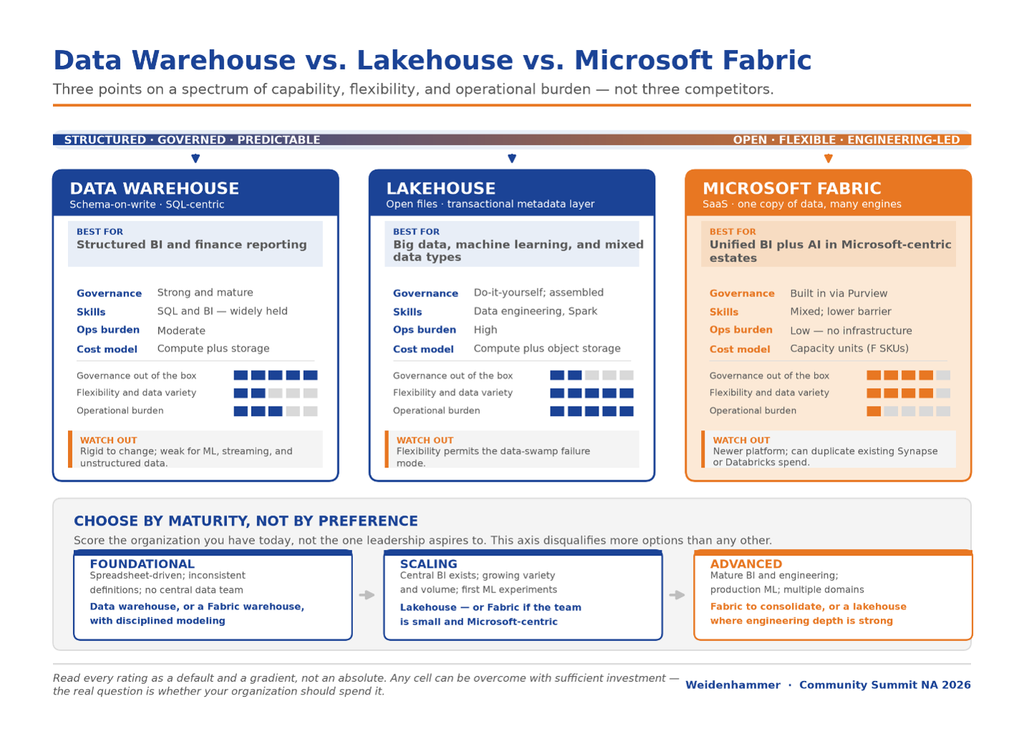
Above all, resist the framing that one platform is the future and the others are legacy. Match the platform to your maturity, your funded requirements, your governance obligations, and your existing investments. Score the options transparently, document the reasoning, present three-year costs honestly, and name the risks. A decision made and recorded that way will stand up to executive scrutiny — and, more importantly, will still look sound in three years.
Recommended immediate action: convene the stakeholders, score your organization against the four axes in Section 8 this month, and inventory every existing platform against the replace, complement, or defer question in Section 7.5 before any purchase decision.
This whitepaper expands the Community Summit NA 2026 session “Data Warehouse vs. Lakehouse vs. Fabric: Making the Right Architectural Choice for Your Organization”. Platform capabilities evolve rapidly; verify current SKU names, feature availability, regional residency, and pricing against vendor documentation before finalizing any procurement or architecture decision.

