
AI-Augmented Software Modernization: Take the Risk and Cost Out of Change
Why Modernization Stalls
Most organizations know their core systems are aging, yet modernization keeps getting deferred.
The path forward often feels expensive, risky, and disruptive. Legacy applications are poorly documented, critical business logic lives in tribal knowledge, and even small changes can introduce unintended downstream impacts. Modernization becomes a high-stake initiative that few teams feel confident executing.
Meanwhile, the gap between organizations that are modernizing and those that are not keeps widening. Every quarter of delay compounds technical debt, limits agility, and raises the cost of future changes.

A Smarter Path Forward
AI is changing the economics of modernization.
Rather than replacing skilled engineers, it augments them. Applied thoughtfully across the software lifecycle, AI removes the friction that has historically made modernization slow and uncertain. It accelerates discovery, clarifies requirements, and acts as an always-on pair programmer.
The result is a more predictable process, with faster delivery, fewer surprises, and significantly reduced risk.
Where AI Augments the Modernization Lifecycle
1. Discovery
AI rapidly analyzes legacy base codes, data models, and integrations to reveal how systems actually function today.
It maps dependencies, identifies unused or redundant code, and reconstructs institutional knowledge that may no longer exist. Work that traditionally takes months of manual analysis can now be done in days, with greater accuracy and completeness.
2. Requirements
AI helps extract the structure requirements form a combination of code, documentation, and stakeholder input.
It surfaces gaps inconsistencies, and ambiguities early, so teams can align on expected outcomes before development beings. This reduces costly rework and keeps modernization efforts grounded in real system behavior.
3. Development
AI accelerates development by assisting with code generation, refactoring, and testing.
It translates legacy patterns into modern frameworks, generates meaningful test coverage, and flags potential defects before they reach production. Engineers remain fully in control while AI handles repetitive tasks and provides real-time insights.
4. Human + AI Collaboration
AI works best as a true partner in development process.
As an always-on pair programmer, it suggests improvements, enforces best practices, and catches issues as they arise, while engineers guide architecture, validate outputs, and make the critical decisions. This model preserves engineering craftsmanship while significantly increasing throughput.
5. Modern Platform
AI helps create a foundation built for the future.
Modernization is not simply about rewriting applications. It is about creating a platform that can scale with business needs, adapt to changing requirements, and support ongoing innovation
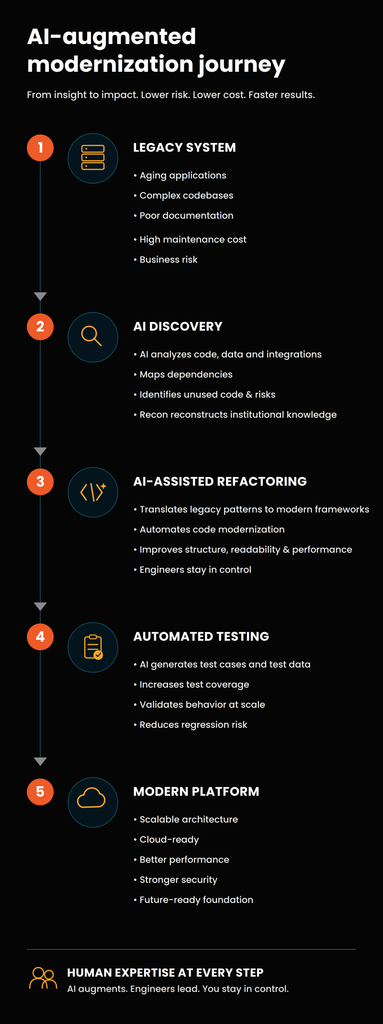
AI helps ensure the modernized solution is built on scalable, cloud-ready architectures that improve performance, strengthen security, and reduce technical debt. By carrying insights forward from discovery, development, and testing, organizations gain a platform that is easier to maintain, faster to evolve, and better aligned with business objectives.
Common Modernization Scenarios We Accelerate
AI-augmented approaches are especially effective across a range of real-world modernization efforts, including:
- Upgrading legacy .NET Framework applications to modern .NET platforms
- Decomposing monolithic applications into scalable, service-based architectures
- Modernizing SQL Server and data platforms for performance and cloud readiness
- Migrating legacy systems (e.g., AS400/DB2, client-server applications) to modern environments
- Replacing brittle, point-to-point integrations with API-driven architectures
Reducing Risk at Every Step
By addressing uncertainty early and continuously validating progress, we turn modernization into a controlled, predictable process. Transformation projects usually fail because of risk, not cost. Our AI-augmented approach is designed to actively mitigate that risk through:
Incremental modernization strategies that avoid high-risk “big bang” rewrites

AI-assisted generation of regression tests to preserve existing functionality

End-to-end traceability form legacy behavior to modern implementations

Early identification of hidden dependencies and edge cases
Parallel validation strategies that compare old and new system outputs
Augmented Delivery Assessment
Before committing to a modernization roadmap, organizations need clarity. Our AI-augmented delivery assessment provides an evidence-based understanding of scope, complexity, and risk, grounded in the actual state of your systems rather than assumptions.
Using AI-driven analysis, we:
Quantify technical debt and
system complexity

Identify modernization patterns
and effort drivers

Surface hidden risks early

Produce realistic, defensible
estimates and timelines
The result is a clear, actionable plan that reduces surprises and improves confidence before significant investments begin.
Responsible and Secure Use of AI
Modernization often involves sensitive systems and data. We apply AI in a way that prioritizes security, control, and accountability.
Our approach includes:
- Use of secure, enterprise-grade AI environments (no exposure to public models)
- Protection of sensitive code and data throughout the process
- Human validation of all AI-generated outputs
- Alignment with regulatory and compliance requirements where applicable
AI is a powerful tool, and we use it responsibly, with governance embedded at every step.

The Weidenhammer Approach
At Weidenhammer, our goal is simple: remove the risk and cost of change.
We combine decades of delivery experience with AI-augmented methods to make modernization a practical, predictable initiative rather than a leap of faith. Through disciplined discovery, evidence-based assessments, and a human-plus-AI delivery model, we absorb uncertainty so our customers don’t have to.
The result is a modernization experience that protects your budget, your timeline, and your operational stability
Organizations that work with Weidenhammer gain not just technical expertise, but a partner that has already solved the hardest part: how to apply AI effectively and responsibly in real-world modernization efforts.
Ready to Modernize Without The Risk?
If your organization has been waiting for the right moment to modernize, that moment has arrived.
AI augmentation has changed the equation, making it possible to move faster, with greater confidence and lower risk than ever before. Talk to Weidenhammer about an AI-augmented delivery assessment and get a clear, low-risk path to modernizing your systems.
Frequently Asked Questions
It is the practice of using AI to support engineers, not replace them, across discovery, requirements, development, and testing. This approach makes modernization faster, more cost-effective, and significantly less risky.
AI improves visibility into legacy systems, clarifies requirements early, generates test coverage, and identifies defects before release. This reduces the uncertainty and late-stage surprises that often derail modernization projects.
No. The most effective approach keeps humans in control, using AI as a pair programmer that handles repetitive work and surfaces insights while engineers make the decisions.
Weidenhammer combines deep delivery expertise with proven AI-augmented methods to reduce the risk and cost of modernization. Our process begins with a grounded delivery assessment and continues with a disciplined, transparent approach to execution.
Ready to Modernize Without the Risk?
Where is technical debt creating the greatest challenge for your organization — in maintenance costs, delivery speed, or system reliability? Schedule a complimentary AI-Augmented Delivery Assessment with Weidenhammer. We’ll evaluate your current applications, identify modernization opportunities, uncover potential risks early, and provide a clear roadmap for moving forward with confidence.