Disconnected commerce and enterprise resource planning systems create a familiar kind of pain. Someone re-keys an order that already exists in the warehouse systems. A price shown online doesn’t match what finance actually agreed to. A buyer calls in because the storefront says “in stock” for something that isn’t.
Get the connection right, and the payoff shows up directly in a better customer experience. You get accurate inventory, correct pricing, and self-service account status that matches the back office and reflects how your business processes actually run. This guide is written for manufacturers, distributors, and wholesalers with complex catalogs and layered pricing, not general-purpose direct-to-consumer retail.

Maybe you’re an operations, IT, or ecommerce leader evaluating a platform migration at a $50M to $1BN+ B2B company. Maybe you’re launching your first ERP-connected online store instead. Either way, this top B2B ecommerce platforms ERP integration roundup covers the ground you need to make smarter decisions.
How We Researched And Selected These Platforms
An ERP-connected B2B ecommerce platform is one where product, pricing, and account information move to and from ERP software as a core part of how the platform operates. It’s not a general-purpose platform with B2B functionality bolted on.
Here’s how we built the list:

Defined the category
We screened for platforms where ERP connectivity is core to the architecture
Sourced candidates broadly
We looked at search demand and feature differentiation, not just market share

Sized the final list
We landed on seven platforms, covering SAP-first, NetSuite-first, headless/composable, and native-B2B buyer segments

Set screening criteria
We required native B2B functionality, proven ERP connectors or APIs, near-real-time synchronization for catalog and pricing, and evidence of production across digital channels at complex-catalog scale

Removed thin options
We cut platforms that layer basic B2B features onto a B2C-first foundation, such as Adobe Commerce or Salesforce Commerce Cloud, since they need far more custom development to match the integrated systems depth of B2B-native platforms
Evaluation Criteria: What “Good” ERP Integration Actually Looks Like
Not every integration platform delivers the same outcome. The gap between “connected” and “actually connected” often appears only after go-live.
| Criterion | What “good” looks like |
| Integrated Readiness | Native connectors, documented APIs, real time data synchronization rather than a fragile custom build |
| Data Synchronization | Catalog, pricing, inventory management, customer data, and order records all in scope |
| B2B-Native Depth | Negotiated terms, account hierarchies, and approval workflows available without custom development |
| Total Cost of Ownership | Implementation and maintenance costs, weighed against real cost savings from fewer manual processes |
| Business Impact | Faster order-to-cash and a genuine competitive advantage from fewer reconciliation errors |
A platform can score well on license price and still cost more overall. Weak integration readiness means paying for the custom work needed to keep back-office and storefront data aligned as your business grows.
ERP Systems Covered In This Guide
We evaluated the platforms in this list against their ability to connect with the ERP systems most common among B2B manufacturers, distributors, and wholesalers.
| ERP System | Typical Company Profile | What Integration Usually Looks Like |
| SAP (ECC/S/4HANA) | Large and upper-mid-market manufacturers and distributors with complex, global operations | Real-time or near-real-time sync via SAP-certified connectors or middleware |
| NetSuite | Mid-market companies running finance, inventory, and order management in one cloud suite | Native API connectors; often a single source of truth for customer and sales data |
| Microsoft Dynamics 365 | Mid-market to enterprise companies standardized on Microsoft’s business applications stack | API-based integration, often via Dynamics-specific connectors |
| Epicor | Manufacturers and distributors, especially in industrial and discrete manufacturing | Middleware or Epicor-specific connectors |
| Infor | Manufacturers and distributors in asset-intensive industries (industrial equipment, food and beverage, fashion) | API and middleware-based sync; connector maturity varies by platform |
| JD Edwards (JDE) | Established manufacturers and distributors, often with heavily customized ERP environments | Custom or middleware-based integration is common; field-level sync is achievable |
Top 7 B2B Ecommerce Platforms For ERP Integration
Each entry follows the same format: a short summary, why it stands out, who it’s best for, key features, and pricing. That way, you can compare all seven on equal footing.
OroCommerce: B2B-Native Platform Built For ERP-Connected Commerce
OroCommerce is an open-source, B2B-first commerce platform in Cloud and Enterprise editions. Oro Inc. (founded by the team behind Magento) built it for manufacturers, distributors, and wholesalers. Its integration approach relies on an open, API-first architecture and a visual workflow designed to connect deeply with back-office systems.
Key Features
- Flexible account hierarchies with complete freedom to configure custom role-based permissions, multiple buyers per account, and a multi-level approval workflows
- Contract pricing, price lists, and RFQ/quote management built in natively
- A combined ecommerce, CRM, and order-management system that gives sales teams and buyers a shared source of truth
- Catalog proven to scale into the millions of SKUs without adding a licensing cost
- AI-assisted search, product recommendations, and storefront and back-office AI assistants included in the license

Why it stands out
- Open architecture and a workflow builder adapts to existing systems instead of forcing a redesign
- Multi-organization, multi-website structure lets each storefront connect to its own ERP instance where needed
- A documented API layer used by an established partner network across SAP, NetSuite, Dynamics 365, Epicor, Infor, and JD Edwards
Best For
- Mid-market to enterprise manufacturers and distributors that need native B2B feature depth without heavy customization
- Companies running multiple brands, regions, or business units from a single backend instance
Pricing
Custom pricing is primarily on GMV and deployment and hosting requirements. OroCommerce does not charge additional license fees per storefront or customer portal.
SAP Commerce Cloud: Enterprise-Grade, SAP-Native Platform
SAP Commerce Cloud (formerly SAP Hybris) is SAP’s cloud commerce solution for B2B, B2C, and B2B2C models. It plugs directly into SAP’s broader ERP environment, giving you one system of recording for pricing, availability, and account data.
Why it stands out
- Native connectivity to SAP S/4HANA and SAP ECC, avoiding fragile middleware for core data
- Complex pricing and available-to-promise inventory logic driven directly by SAP records
- A composable storefront architecture that lets front-end and integration layers evolve independently

Best For
- Large, SAP-centric enterprises running multi-country B2B and B2B2C operations
- Organizations that need consistent order processing across ecommerce, EDI, phone, and other channels
Key Features
- Omnichannel promotion and pricing management across every touchpoint
- Product catalog management built for high-SKU-count environments
- AI-driven personalization and search built into the storefront
- Bulk ordering and configure-price-quote (CPQ) support for complex product bundles
- Payment processing and tax integration handled within the same order-to-cash flow as S/4HANA
Pricing
SAP doesn’t publish list pricing. Implementation partners report license costs typically running from roughly $150,000 to $500,000+ per year, depending on the GMV tier and order volume.
Commercetools: Headless, API-First Platform For Composable Integration
Commercetools is a MACH-certified (Microservices-based, API-first, Cloud-native, Headless) commerce platform. It added dedicated B2B functionality to its Composable Commerce offering, built around modular, best-of-breed connectors rather than one fixed layer.
Why It Stands Out
- An API-first design that treats ERP and CRM systems as interchangeable, swappable components
- A Business Units model that maps company accounts and buyer roles to however your ERP already structures them
- A flexible platform that lets teams upgrade one integration component without a full replatform

Best For
- Enterprises with in-house engineering teams that want independent building blocks
- Organizations running multiple business models (B2B, B2C, D2C) on one commerce engine
Key Features
- Business units, budget controls, and multi-level approval workflows for enterprise business accounts
- Thousands of negotiated pricing agreements and contract terms manageable from a single system
- Quote management and buyer approval flows native to the B2B product line
- Pre-built accelerators from systems integrator partners that speed up deployment
- Tools built to strengthen customer relationships through consistent pricing and account data across channels
Pricing
Commercetools doesn’t publish pricing as a fixed rate. Plans are scoped around usage and the specific modules a business uses, with quotes provided through the company’s sales team.
NetSuite SuiteCommerce: Unified Suite With Native ERP Ties
NetSuite SuiteCommerce is Oracle NetSuite’s built-in ecommerce platform. It runs inside the same database as NetSuite’s ERP, inventory, and financial modules.
The storefront and the ERP share one system of record, so there’s no synchronization layer between them. Place an order online, and it becomes a NetSuite sales order the moment you submit it.
Why It Stands Out
- A zero-middleware, single platform architecture: webstore, inventory, orders, and customer records all live in one database
- Customer-specific pricing pulled directly from a customer’s assigned price level with no separate sync step
- Real-time inventory visibility across warehouses, retail locations, and drop-ship partners from the same system that runs financials

Best For
- Companies already running their back office on NetSuite that want a single storefront
- Manufacturers and distributors that sell through multiple sales channels, including reps, wholesale partners, and web from one dashboard
Key Features
- Negotiated rates and price levels applied automatically per account
- Quote-to-order workflow with online RFQ requests and one-click reordering from purchase history
- Volume discounts applied automatically as order quantities increase
- A self-service account management portal (MyAccount) for balances, invoice payments, and order tracking
- Unified customer accounts and order history across every channel the business sells through
Pricing
SuiteCommerce is typically licensed in two tiers. Standard runs roughly $2,499/month, and Advanced runs roughly $4,900/month; implementation is billed separately.
Sana Commerce: ERP-embedded B2B Commerce
Sana Commerce Cloud runs on top of SAP or Microsoft Dynamics ERP systems, reading and writing live ERP data at runtime instead of syncing to a separate database. That’s Sana’s core differentiator: no middleware layer between the storefront and the ERP to maintain.
Why It Stands Out
- Native, vendor-maintained connectors for SAP S/4HANA, SAP ECC, SAP Business One, and Microsoft Dynamics 365
- Volume pricing, stock levels, and customer preferences pulled live from the ERP on every page load rather than cached separately
- Purpose-built for B2B manufacturing, distribution, and wholesale rather than adapted from a general storefront

Best For
- Mid-market and upper-mid-market manufacturers and distributors already standardized on SAP or Microsoft Dynamics
- Companies that want to minimize data mapping and middleware maintenance
Key Features
- Pricing and contract terms read live from the ERP at every login, keeping inventory accuracy consistent between systems
- Real-time order status directly from ERP records, with no separate reconciliation step
- Multiple web stores served from a single ERP connection for different regions or brands
- Self-service portal for order history, invoice downloads, shipment tracking, and account management, available around the clock
- A steady data flow between storefront and ERP that eliminates duplicate data entry for customer service teams
Pricing
Sana Commerce doesn’t publish standard pricing. The company provides quotes based on ERP system, catalog size, and the number of storefronts you plan to run.
HCL Commerce: Enterprise Platform With Deep Integration Heritage
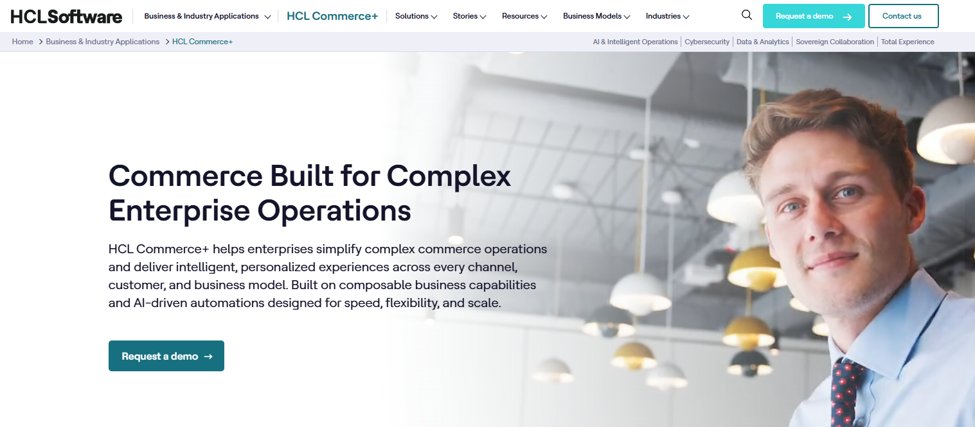
HCL Commerce (formerly IBM WebSphere Commerce) is an enterprise ecommerce platform supporting B2B, B2C, B2B2C, and D2C models from a single codebase. Its integration approach reflects nearly two decades of enterprise deployment history
Why It Stands Out
- A long-standing enterprise heritage, with pre-built connectors refined across large-scale B2B deployments
- A multi-catalog, product-entitlement architecture that maps cleanly to ERP-driven customer segmentation
- A composable design that lets integration and front-end components be upgraded independently of the core platform
Best For
- Large enterprises with complex, long-tenured ERP environments and legacy integration requirements
- Organizations running multiple business models and storefronts from one back-end instance
Key Features
- Custom enterprise pricing and contract management built for B2B buyers
- Multi-catalog support with product entitlements for different customer segments
- AI-driven search, personalized recommendations, and predictive pricing built into the platform
- Multi-site, multi-brand, and multi-language management from one instance, giving sales representatives a consistent view of every account
- Order capture and post-order management integrated with existing back-office systems
Pricing
HCL doesn’t publish list pricing. Commercial terms are negotiated per customer based deployment scope.
Kibo Commerce: Composable Commerce For Mid-Market And Enterprise B2B
Kibo Commerce is a MACH-certified composable platform unifying B2B and B2C ecommerce, order management, and AI-driven merchandising on a single API-first architecture. Modular Packaged Business Capabilities (PBCs) let you connect Kibo to an existing ERP incrementally rather than through one all-or-nothing project.
Why It Stands Out
- Modular capabilities that let teams integrate specific commerce functions without a full replatform
- Real-time inventory data and order orchestration designed to sit alongside existing warehouse and fulfillment systems
- An API-first design intended to streamline workflows during migration rather than force a disruptive cutover

Best For
- Mid-market distributors and manufacturers with an IT team capable of managing a composable stack
- Businesses that want to add ecommerce, order management, or subscriptions independently, not one monolithic suite
Key Features
- Quote management purpose-built to handle complex pricing in B2B buying scenarios
- Account-based ordering with price lists, approvals, purchase orders, and account hierarchies out of the box
- Available-to-promise and capable-to-promise inventory logic across locations and channels
- AI-powered search and AI agents that respond to customer behavior in real time for merchandising and service
- Order management with intelligent routing and a unified call-center view of every order
Pricing
Kibo Commerce pricing isn’t published. The company offers modular, phased pricing based on which capabilities a business uses, with quotes available directly from Kibo.
Quick Comparison Of ERP Integration Strengths
Here are the same seven platforms side by side, in the order covered above, so you can jump straight to the ones worth a closer look.
| Platform | Best For |
|---|---|
| OroCommerce | Native B2B feature depth without heavy customization |
| SAP Commerce Cloud | SAP-centric enterprises |
| commercetools | API-first, headless, composable architectures |
| NetSuite SuiteCommerce | Companies unified on NetSuite ERP |
| Sana Commerce | SAP/Dynamics-embedded commerce with minimal data mapping |
| HCL Commerce | Large enterprises with deep legacy integration needs |
| Kibo Commerce | Mid-market distributors with mature IT teams to handle a composable stack |
How To Choose The Right Ecommerce Platform For ERP Integration
Picking from the list above comes down to matching the platform’s integration model to how your business actually operates. The best ecommerce platform is whichever one fits your ERP, not the one with the longest feature list.
- Map your needs to your ERP’s actual data-exchange pattern (real-time, batch, or middleware-dependent)
- Prioritize platforms that preserve accurate data as information moves between the ERP and the storefront and back
- Match the sync approach to each domain based on your buying process: pricing may need instant updates, while historical order records can run on a schedule
- Weigh implementation and data migration cost against the labor and error reduction you’ll get in return
- Validate the partner ecosystem specifically from your ERP, not just the platform’s general market presence
Introducing OroCommerce
OroCommerce is an open-source, B2B-first commerce platform, available in Cloud and Enterprise editions, built specifically for complex B2B selling rather than adapted from a B2C foundation.
Oro Inc. founded by the team behind Magento, built B2B logic into the platform from day one rather than retrofitting it through plugins. You can explore the full feature set on OroCommerce’s B2B ecommerce platform page.
This modern ecommerce platform is best suited for mid-market to enterprise manufacturers, distributors, and wholesalers that need their storefront to reflect real pricing and catalog complexity. Multi-organization and multi-website architecture lets one company run several brands, regions, or business units from a single backend instance.
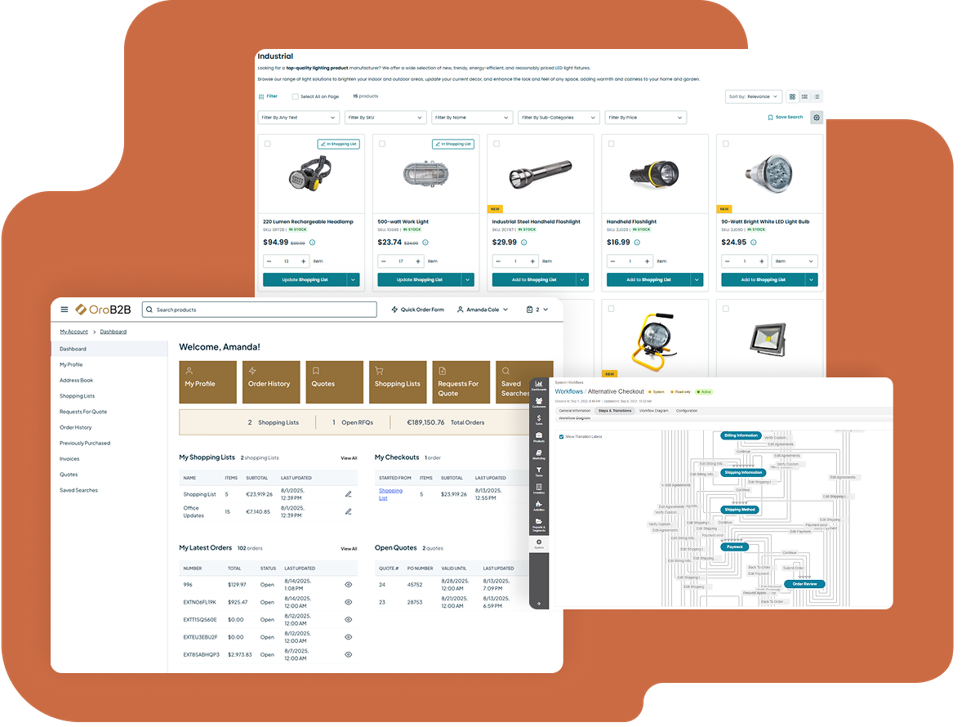
Core commerce logic reflects how B2B actually sells: tiered pricing, quote and RFQ/RFP management, and account hierarchies with role-based permissions and approval workflows.
An open, extensive architecture and workflow engine connect deeply with ERP and customer relationship platforms. That’s what enabling businesses to treat back-office data as a feature, not an afterthought, actually looks like.
From Platform to Production: OroCommerce and Weidenhammer
Choosing a platform is only half the equation. The other half is who implements it.
About The Collaboration
Weidenhammer is a Connected Growth Partner for B2B companies with complex commerce needs. It unifies commerce strategy, implementation, and digital marketing under one team instead of splitting the work across separate vendors.
The company runs a team of roughly 100 to 120 people. That team brings production-proven experience connecting commerce platforms to SAP, NetSuite, Microsoft Dynamics 365, Epicor, Infor, JD Edwards, and legacy or proprietary systems.
Proven At Scale: PEI Genesis On OroCommerce
Weidenhammer’s flagship OroCommerce deployment, for connector and electronics distributor PEI genesis, shows what deep ERP integration looks like at real-world scale:
- About 1.77 million products live in production as of mid-2026, backed by a custom pricing API handling roughly 1 billion price records in real time
- A five-level pricing waterfall expressed directly at the storefront, spanning four currencies and five regional warehouses
- A quote-to-order workflow built for line-item purchasing, multiple status stages, tariff calculation, and ERP item mapping
- Complex multi-entity, multi-currency payment routing delivered at order creation
- Below-the-surface engineering (performance tuning, reindexing, and price-merge logic) that keeps a catalog this size usable in daily operations
- Navigation and usability outcomes including hundreds of organized categories, click-throughs cut from six to two, and product management shifted from code-level changes to structured admin tools
Taken together, these engagements show why the OroCommerce and Weidenhammer pairing works.
OroCommerce brings the open, B2B-native architecture built to handle ERP connections, contract pricing, and complex catalogs without heavy customization.
Weidenhammer brings the ERP expertise, across SAP, NetSuite, Dynamics 365, and beyond, to turn that architecture into a production system that reflects how a business actually prices, fulfills, and sells.
That combination is what turned a catalog of 1.77 million SKUs into a usable storefront for PEI Genesis, and it’s worth evaluation if OroCommerce is on your shortlist.

Implementation Checklist For Successful ERP-Ecommerce Integration
- Document every data domain that needs to sync between systems, including product data and ecommerce data such as pricing, inventory, and orders, and assign clear project management ownership for each
- Map source-to-target fields for product and price records before writing integration code, and plan the cutover in phases rather than one single move
- Choose a sync cadence for each domain (instant for inventory and pricing, scheduled where appropriate) to prevent oversells and mismatched checkout totals.
- Test end-to-end flows into the ERP before go-live, including edge cases like split shipments and multi-currency orders
- Set up monitoring for failed imports and reconciliation exceptions so issues surface before customers notice them
Final Words About Top B2B Ecommerce Platforms (ERP Integration)
Run a short ERP-readiness audit before you commit to a platform. Confirm what data your ERP can expose and how clean it is. That often reveals more about true implementation cost than any feature list, and it protects against transaction feed and rework that surface after go-live.
Engage an integration partner with proven connectors for your specific ERP, and pilot on a subset of SKUs before a full migration. That way, accurate pricing and inventory sync get validated on real orders, supporting sales growth once the full catalog goes live.
FAQs About Top B2B Ecommerce Platforms (ERP Integration)
Platforms built B2B-first tend to outperform B2C-first platforms retrofitted with B2B extensions. For companies with layered pricing and back-office connectivity needs, that group includes OroCommerce, SAP Commerce Cloud, NetSuite SuiteCommerce, Sana Commerce, commercetools, HCL Commerce, and Kibo Commerce.
Beyond the seven covered in this guide, other platforms frequently mentioned in B2B ecommerce comparisons include Adobe Commerce, Shopify Plus, and BigCommerce. These generally require more custom development to reach the same depth of native B2B and back-office connector functionality.
SAP, Oracle NetSuite, and Microsoft Dynamics 365 are consistently cited as the three most widely deployed ERP systems by market presence. That’s especially true among mid-market and enterprise manufacturers and distributors.
Amazon relies primarily on a proprietary, internally built set of systems for inventory, fulfillment, and order management rather than a commercial off-the-shelf ERP package. That reflects the scale and custom logistics requirements of its retail and marketplace operations.