About the Author

Watch the Full Conversation
The Inflection Period is Here
Most technology shifts hit like a single lightning strike: everything changes, then stabilizes. AI is inherently different. It’s an inflection period—an endless current of change that forces leaders to adapt continuously or risk being left behind.
According to McKinsey’s latest global survey, 78% of respondents say their organizations use AI in at least one business function, up from 72% in early 2024 and 55% a year earlier. Yet despite this widespread adoption, only 1% believe they’re at maturity. The gap between enthusiasm and execution has never been wider.
AI can potentially be as transformative—perhaps even more so—than the advent of the internet. But unlike the internet boom, where we quickly understood how publishing and information access worked, AI remains more complex and less predictable. We understood the internet’s mechanics relatively quickly; with AI, what felt true six months ago may already be outdated.
That volatility is what makes this an inflection period, not a point in time. Leaders can’t “wait for the dust to settle” because the sand beneath our feet is shifting too fast.
For mid-market companies, this volatility is an opening. You have the agility that enterprises lack and the customer closeness startups envy. Without the bureaucratic drag (and with more stability than scrappy upstarts) you’re uniquely positioned to make turbulence work in your favor.
The purpose of this guide is simple: Offer a clear, actionable roadmap for mid-market leaders. We’ll cover the fundamentals that must come first, the human factors that drive adoption, the practical applications already delivering results, and a framework for scaling with confidence.
AI isn’t a single moment of change. It’s a period of constant evolution, demanding leaders stay engaged, curious, and ready to adapt.
Security and Readiness First: The Non-Negotiables
Let’s set the shiny tools aside for a moment. AI only creates lasting value when security and readiness come first. Skip this step, and results will be unreliable—and risks will grow.
Banning AI won’t make the risk disappear. It simply pushes usage into the shadows, where it’s harder to manage safely.
- Malicious actors are already ahead. They’ve been using AI for years to exploit vulnerabilities. If your team doesn’t understand how AI works or how to spot potential threats, you’re leaving the door wide open.
- Shadow AI is rising fast. Employees are using unauthorized AI tools without realizing the governance and security implications. Trying to prohibit AI only drives it underground, creating a bigger, riskier version of shadow IT.
The Guardrails vs. Prohibition Approach
Instead of banning AI, you need policies, procedures, tools, and structures that create guardrails. That’s what your users want, and it’s how you can keep innovation secure. That means:
- Clear usage policies developed with input from real users, not just IT and legal
- Approved tools and platforms that meet your security standards
- Training so people understand both AI’s potential and its pitfalls
- Ongoing monitoring as the tech and the threats evolve
Instead of banning AI, you need policies, procedures, tools, and structures that create guardrails. That’s what your users want, and it’s how you can keep innovation secure.
Data Quality and Security Go Hand-in-Hand
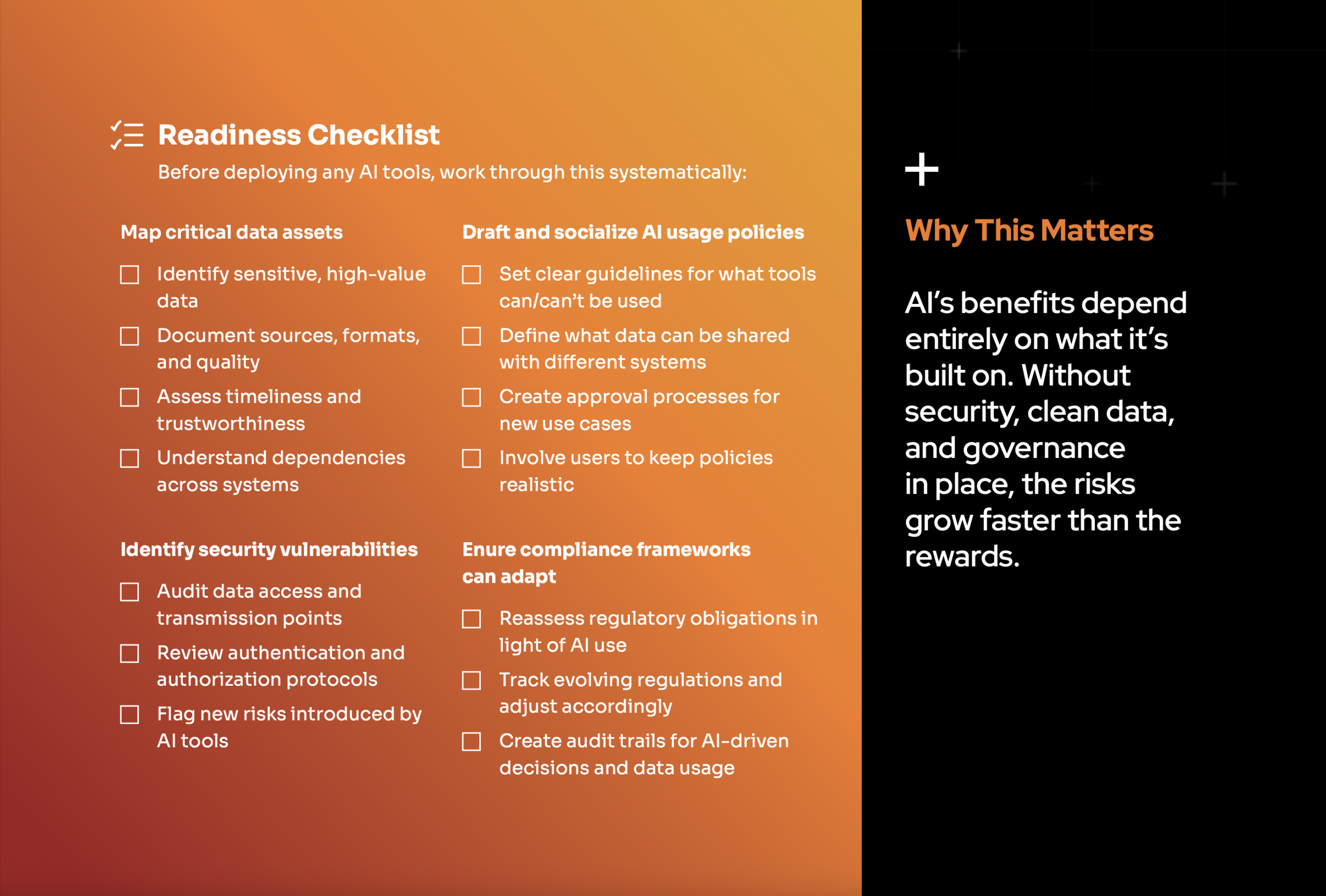
Most organizations are nowhere near ready for meaningful AI. The core issue: AI can’t deliver reliable value without clean, secure data.
We’ve all had more data than we can practically use for years. Multiple data sources, varying degrees of currency and trustworthiness, and inconsistent formats make it difficult for humans to sort through, let alone machines. This has always been true for traditional business intelligence, but AI amplifies the issue.
Readiness Checklist
Human-Centric AI Adoption
AI success is as much about human factors as it is about technology. The organizations that get the best results from AI are the ones that understand this fundamental truth and build their adoption strategies around people, not just platforms.
The Communication Skills Advantage
Here’s what surprises many leaders: People with strong management and communication skills often adapt to AI faster than technical staff. Sounds a bit counterintuitive, right? But it’s true because AI behaves more like a person than a machine.
Traditional computing is predictable—A goes in, B comes out. AI is contextual. It requires the same nuanced skills great managers use every day: giving clear instructions, thinking through implications, and anticipating misinterpretations. If you’re good at explaining context, setting expectations, and offering feedback, you’re likely good at prompting AI to deliver useful results. In practice, the people who work best with people often work best with AI.
Overcoming Resistance Through Exposure
People naturally resist change, and AI represents a significant change for most organizations. But resistance often melts away once people actually try AI and see what it can do for them personally.
The key is exposure through low-risk pilot projects that demonstrate clear, practical benefits. When someone skeptical about AI uses it to draft an email, summarize a meeting, or analyze a data set they’ve been dreading, and sees it work well, their perspective often flips completely.
Early pilot projects should focus on:
- Tasks people actively dislike doing, but have to do anyway
- Clear, measurable improvements in speed or quality
- Low-stakes environments where mistakes don’t have serious consequences
- Individual benefits that people can experience personally
Change Management for AI
Successful AI adoption requires a structured approach to change management:
- Identify champions – Curious, influential employees who can explain benefits in business terms
- Run proofs of concept – Start small, with high-likelihood wins that build credibility
- Share use cases – Create forums for employees to share successes and lessons learned
- Provide ongoing training – Offer continuous learning pathways; AI evolves too quickly for one-and-done training
Building AI Fluency Throughout the Organization
At Weidenhammer, building AI fluency is deliberate. Training is continuous, but so is peer-to-peer sharing. Teams use group chats to post real examples of how they’ve applied AI, making it easier for others to replicate success.
We also treat AI as a “third contributor” in problem-solving discussions. Whether tackling a client challenge or an internal process, AI is always considered a potential part of the solution. This keeps adoption visible, practical, and ingrained in daily work.
People who excel at working with people often adapt to AI faster than those with purely technical skills. In many ways, AI behaves more like a person than a machine.
Practical Use Cases and Misconceptions
The technology is here. What holds companies back is the lens they use to judge it—one that often sets impossible standards and blocks progress.
Busting the Perfection Myth
The most common misconception: AI has to be flawless to be useful. Leaders expect absolute accuracy because traditional computing always delivers the same output, but AI doesn’t work that way.
A better benchmark is the “best available human” standard. If an employee makes errors 15% of the time, and AI makes errors 10% of the time while working ten times faster, that’s progress. The question isn’t “Is it perfect?” It’s “Is it better than our current alternative?”
This applies to quality, too. The best human writers outperform AI, but for employees who struggle, AI raises the floor of performance with little risk. It’s less about raising the ceiling than ensuring a higher baseline across the organization.
Don’t compare AI to perfection—compare it to your best available human. That’s the real benchmark for performance.
Real-World Impact: Customer Service in Action
A personal example illustrates AI’s potential. I called my satellite radio provider to cancel or negotiate my subscription. An AI agent answered, gathered context through natural conversation, pulled up my account, and handed me off to a human agent who already had the full picture.
The result was a faster, smoother interaction:
- Customer: Positive experience, no endless phone menus
- Company: Retained customer, greater efficiency
- Agent: More time for meaningful work
This is the model of AI-human collaboration, where machines handle repetitive tasks; people focus on relationships and decisions.
Speed to Adoption vs. Proprietary Models
For mid-market firms, the smart play is speed to adoption. Building proprietary AI models is costly, slow, and quickly outdated. Frontier models already benefit from hundreds of millions in R&D. The better approach is to build interfaces and applications that apply existing AI to your business needs. With the tech evolving so fast, agility beats ownership.
Where AI Delivers Value vs. Where It Wastes Time
AI excels at:
- Speed and efficiency in repetitive tasks
- Quality improvements for weaker skill areas
- Large-scale data analysis and pattern recognition
- Customer service responsiveness
- Drafting and editing internal communications
AI falls short at:
- High-stakes decisions commanding judgment
- Creative work demanding originality and brand nuance
- Complex problem-solving requiring domain expertise
- Relationship building rooted in trust
- Strategic planning requiring deep business context
Continuous Testing and Adaptation
In an inflection period, nothing is static. What failed six months ago might succeed today, and vice versa. The only way forward is a culture of experimentation: keep testing, share results, refine approaches, and repeat.
A Framework for Sustainable AI Adoption
AI adoption is a cycle—assess, implement, optimize—that repeats as technology evolves and business needs shift. Weidenhammer has refined this process to deliver results while minimizing risk: Spark, Ignite, and Shield.
Spark: Start with Strategy
Every AI journey begins with clarity. Before evaluating tools, define the outcomes you want. Ask:
- What problem are we solving?
- What does success look like in measurable terms?
- Which processes or structures contribute to the issue?
- Could this be solved without new technology?
Only after setting objectives do we explore solutions. Sometimes that’s AI, sometimes it’s automation, and sometimes it may just be a process change.
Ignite: Implement and Execute
Next comes disciplined execution. The “Ignite” phase focuses on:
- Pilots with clear outcomes
- User training and change management
- Integration with existing systems
- Continuous monitoring and optimization
Shield: Ongoing Protection and Optimization
AI is never a “one-and-done” project. Shield ensures long-term impact through:
- Security monitoring and policy enforcement
- Performance tracking and improvement
- Staying current with new capabilities and risks
- Scaling successful use cases across the business
Our role is to be the sherpa, guiding clients to understand the why before deciding on the how.
Why This Approach Works
AI isn’t siloed; it touches infrastructure, applications, customer experience, and go-to-market strategy. That’s why integrated expertise is so important. And it’s why we’ve formalized this three-phase cycle that blends IT, application development, business systems, and omnichannel expertise under one roof.
We share it here not as a rigid prescription, but as a model for how mid-market leaders can structure their own AI programs: Start with strategy, execute with discipline, and commit to ongoing optimization.
Guidance matters, but so does gear. That’s why, through our Commerce and Omnichannel practice, we pair leadership with the practical tools—strategy, services, GEO/SEO optimization, and AI-growth engine implementations—that make growth sustainable.
Lead, Don’t Follow, in the AI Inflection Period
You can’t wait for the dust to settle with AI—by then, you’ll already be behind. Companies across industries are moving quickly, and those that start now with a security-first, people-centered approach will gain the advantage.
Success requires continuous engagement, ongoing learning, and the courage to adapt as technology evolves.
Start Small, Move Fast
The path forward begins with action today:
- Assess security and data readiness
- Identify champions to lead adoption
- Launch low-risk pilots with clear benefits
- Establish guardrails that enable safe innovation
- Build continuous learning into your process
Think Beyond Optimization
Efficiency gains are only the start. The real breakthroughs come when leaders reimagine processes entirely. If AI can shrink a three-day workflow to 30 minutes, maybe that workflow shouldn’t exist at all.
The Mid-Market Edge
Mid-market companies are uniquely positioned to move quickly:
- Agility to test and iterate
- Direct customer insight into practical use cases
- Faster decision-making than larger competitors
AI won’t slow down for you. The only question is whether you’ll slow yourself down by waiting.